



Cookies 🍪
By clicking "Accept", you authorize Meilleur du Chef to store cookies on your device to personalize site content, analyze our traffic, and provide social media functionality.


Favourites



In one click, store and find all your favourite recipes.
Add this recipe >Once voted France's favourite meal, Veal Blanquette is a timeless 18th-century classic credited to François Marin, steward to the Marshal de Soubise. Its name celebrates the "whiteness" of the dish—achieved by gently blanching the meat and simmering it in a velvety cream sauce. Originally an elite bourgeois delicacy reserved for the aristocracy, it evolved during the 19th century and WWII into a beloved household staple. Today, it stands alongside Beef Bourguignon as a pinnacle of slow-cooked French comfort.

To make this traditional veal blanquette recipe, start by preparing all the ingredients.

Blanquette base: Place a stewpot on the hob.

Put the veal pieces into the stewpot...

...and fill it with water until the meat is covered. Bring to a heat.

Meanwhile, prepare the aromatic garnish vegetables. Start by cleaning the leek, cutting a cross into the green part. Then rinse the leaves under cold running water.

Peel the garlic cloves...

...as well as the carrots.

Prepare a bouquet garni consisting of leek leaves, a celery stick, parsley, thyme, and bay leaf. Tie the bouquet securely with twine so that it holds together during cooking. All vegetables must be kept whole.

The blanching of the meat begins.

Once the water reaches a boil...

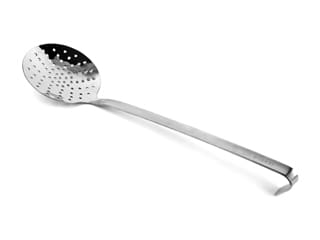
...remove the scum forming on the surface using a skimmer.

Blanch the meat for 5 minutes.

After 5 minutes, remove the meat pieces...

...draining them in a colander.

Discard the blanching water and clean the stewpot for the actual cooking of the blanquette.

Put the meat pieces back into the stewpot.

Add all the aromatic garnish vegetables (leek, carrots, onion, cloves pricked into the onion, bouquet garni, celery stick, and garlic). All these vegetables are whole.

Pour in cold water until covered. The water must cover all the meat pieces as well as the vegetables.

Bring everything to a boil.

Once boiling, maintain a gentle simmer for 1 hour.

After 1 hour, the meat begins to cook. It is important to know that meat contains collagen. If cooked at too high a temperature, it will harden and become elastic. If the meat is cooked slowly at a low temperature, the collagen will become tender. Therefore, to obtain a tender veal blanquette, the cooking must be slow and steady, lasting 1 hour 30 minutes to 2 hours.

When the meat is cooked, remove it from the broth.

Also remove the bouquet garni and the vegetables...

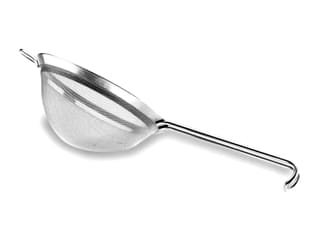
...then filter the broth through a fine mesh strainer over a saucepan.

Set this broth aside.

White-glazed pearl onions: Place the peeled pearl onions in a saucepan and cover them with water (15 to 20cl). Add a knob of butter, fine salt, ground pepper, and the caster sugar.

Make a parchment paper lid. To do this, fold a sheet of greaseproof paper and cut it with scissors to a diameter slightly larger than the saucepan. Cut a hole in the centre to act as a chimney.

Place this parchment lid directly in contact with the onions. Let cook until the water has completely evaporated. Here we are performing a "glaçage à blanc" (white glazing), so the onions must remain white without browning.

White-glazed mushrooms: Meanwhile, prepare the mushrooms. Start by washing and slicing them.

Place the mushrooms in a saucepan. Just like with the onions, add the caster sugar...

...and a nice knob of butter.

Cover with water (15cl)...

...and season with fine salt and ground pepper.

Make a parchment lid as before and position it in contact with the mushrooms.

Cook the mushrooms until the water has completely evaporated. They must remain white, without browning.

At the same time, the pearl onions are cooked. Remove the parchment lid.

We achieve this result.

Continue the reduction until there is no more water. Be careful not to colour the onions. When there is no more liquid, stop the cooking...

...and pour the white-glazed onions over the cooked meat pieces.

Do the same with the mushrooms, adding them to the meat and onions.

Here is the result.

Blanquette sauce: Prepare a white roux. To do this, melt the butter in a saucepan.

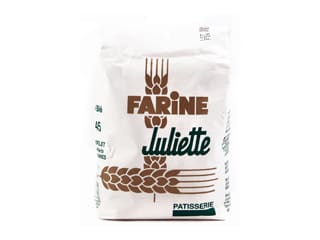
When the butter is entirely melted, add the flour all at once.

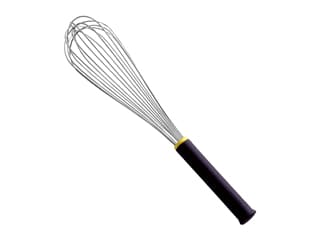
Mix with a whisk to form a white roux. Be careful not to let it colour, otherwise you will not have a white roux (white sauce), but a brown roux (brown sauce). The goal of this blanquette recipe is to keep the sauce white.

When the white roux is ready, let it cool to room temperature. Meanwhile, bring the reserved broth (from step 25) to a boil.

When the broth is boiling, pour between 1 litre and 1.5 litres of it over the cold white roux while whisking.

Bring to a boil and cook for a few minutes to thicken the broth with the roux. If the sauce is too thin after a few minutes, continue cooking and stirring regularly to reduce it to the desired consistency. Here we are using the Béchamel technique = white roux + liquid (milk or broth).

To bind the blanquette sauce, mix the egg yolks and crème fraîche in a bowl.

Pour this mixture into the hot broth (be careful, the broth must not be boiling). Whisk well and add a drizzle of lemon juice.

Pass the resulting blanquette sauce through a fine strainer over the meat pieces, onions, and mushrooms.

Carefully mix all these elements together with a spatula to bind everything. Adjust the seasoning if necessary.
This veal blanquette can be eaten immediately. However, it will be better if placed in the fridge for 24 hours to allow the flavours to develop fully. It can be kept cold, covered with cling film in direct contact, until the next day. Simply reheat your blanquette slowly over low heat, stirring regularly with a spatula. Bon appétit!

Please login to post a review