



Cookies 🍪
By clicking "Accept", you authorize Meilleur du Chef to store cookies on your device to personalize site content, analyze our traffic, and provide social media functionality.


Favourites



In one click, store and find all your favourite recipes.
Add this recipe >
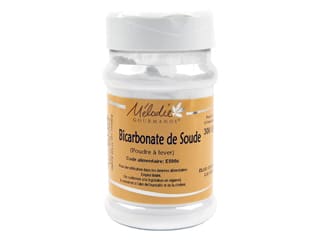
Hard-boiled eggs: To make this deviled eggs recipe, start by preparing the hard-boiled eggs. To do this, fill a saucepan halfway with cold water. Add the baking soda. This is optional but it will make it easier to peel the eggshells.

Make sure you use food-grade baking soda.

Place the eggs in the saucepan and bring to a boil (starting with cold water).

Once boiling, maintain a gentle simmer for 10 minutes.

After cooking, cool the eggs by running a stream of cold water into the saucepan until the water in the saucepan is completely cold (or transfer them to a mixing bowl filled with ice water), and gently peel them one by one without damaging the white.

Place the peeled eggs in a salad bowl while waiting to be dyed.

Yellow dye: Pour ground turmeric into a mixing bowl. The amount depends on how intense you want the colour to be. I used a heaped tablespoon.

Then add boiling water while stirring with a whisk to fully dissolve the turmeric powder in the water.

Submerge the hard-boiled eggs in the warm tinted water, making sure they are fully immersed.

Leave the hard-boiled eggs to soak for at least 6 hours so that the colour of the turmeric permeates the egg whites.

When the eggs are well dyed, rinse them under clean water. At this stage the surface of the egg whites should have turned orange.

Preparation: Cut the eggs in half lengthwise with a chef's knife.

Then remove the yolk from inside each egg, being careful not to damage the white.

Rinse the egg whites in water to remove any excess egg yolk remaining in the cavities. Pat the egg whites dry on paper towels...

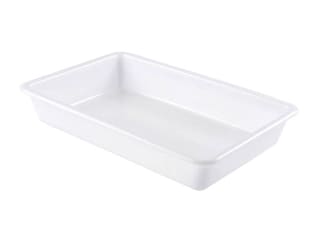
...before placing them in a food container.

This is what the result should look like.

Place the egg yolks in a sieve...

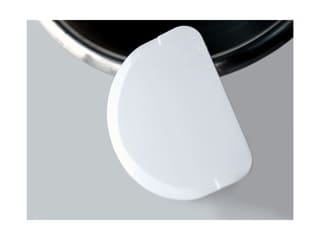
...and press them through the sieve using the back of a spoon (or dough scraper)...

...to collect the egg yolk vermicelli in a container.

Using a dough scraper, gather all the egg yolk vermicelli left sticking under the sieve.

The egg yolk vermicelli are the base for the filling.

Mayonnaise: Separate the eggs and place the yolks in a mixing bowl. They must be at room temperature.

Season these egg yolks with fine salt...

...and freshly ground black pepper.

Add the Dijon mustard...

...and mix these ingredients together. Then pour in the sunflower (or peanut) oil in a thin stream.
It is important to incorporate the oil very slowly, otherwise the mayonnaise will split.

Gradually, the emulsion will form and the mayonnaise will thicken. We want to achieve a firm consistency, as shown in the photo.

Finish: Finely chop the fresh chives with a knife...

...as shown in the photo.

Place 2 to 3 tablespoons of mayonnaise in a container...

...and add roughly equal amounts of egg yolk vermicelli.

Mix gently. At this stage, you can add a tablespoon of wholegrain mustard. This remains optional. You need to obtain a firm texture that can be piped using a pinping bag.

Adjust the seasoning if necessary, and transfer the preparation into a piping bag fitted with a star nozzle Ø 18mm.

Pipe a nice swirl of filling inside each egg white...

...as shown here in the photo.

Repeat the operation with all the egg white shells.

Dust the surface of the swirls with a pinch of smoked paprika, lightly tapping with your finger on the tip of the knife.

Then sprinkle the finely chopped chives over the surface of the deviled eggs.

Here I'm going to show you two finishing options. The first with yellow pansies and the second with purple pansies. To do this, pick a yellow pansy flower directly from the plant and gently place it on the deviled egg. Press softly to make it stick.

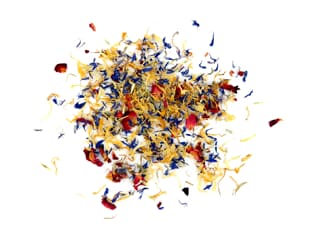
Sprinkle a few dried cornflower petals or an edible flower petal mix over the remaining deviled eggs...

...as well as chopped chives.

Finally, place a purple pansy flower directly picked from the plant onto these deviled eggs...

...to achieve this result.

Our beautiful devilled eggs are now done. Arrange them on a serving platter, alternating colours for a harmonious result. Keep in the fridge until ready to serve.
Enjoy!

Although all these techniques work to varying degrees of success, the age of the egg and the thermal shock caused by the cold remain the most effective factors.
Please login to post a review